Frequently Asked Questions
The most-asked questions about duchies and electorates of the holy roman empire.
What is this encyclopedia about, and what time period does it cover?
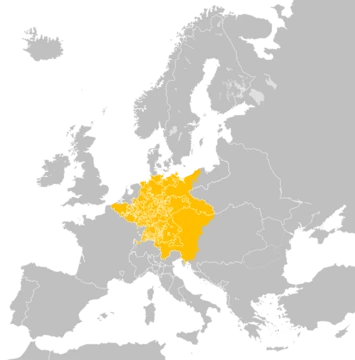
It documents the duchies and electorates that constituted the Holy Roman Empire from the medieval period through its dissolution in 1806. These were semi-autonomous territorial states whose rulers occupied specific ranks within the Empire's layered political hierarchy.
What's the practical difference between a duchy and an electorate?
A duchy was a territory governed by a duke as a vassal of the emperor, while an electorate was a territory whose ruler additionally held the right to vote in selecting the emperor. The seven electorates received that privilege through the Golden Bull of 1356.
Who were the seven electors, and what did they actually do?
The electors comprised the Archbishops of Mainz, Trier, and Cologne; the King of Bohemia; the Duke of Saxony; the Count Palatine of the Rhine; and the Duke of Brunswick-Lüneburg (added in 1692). Together they formed the College of Electors whose sole constitutional function was to choose the Holy Roman Emperor.
Which duchies are the most prominent and frequently referenced?
Bavaria, Austria, Saxony, Brabant, and Carinthia are among the best-known, each tied to a distinct dynastic lineage and regional identity. Several, including Bavaria and Saxony, later acquired electoral status, which significantly raised their political standing within the Empire.
Where should a newcomer begin reading?
Start with the Golden Bull of 1356, which codified the electoral process and defined the legal rights of major territorial rulers. From there, tracing the Habsburg, Wittelsbach, and Wettin houses provides context for most of the Empire's internal political drama.
How much real power did the emperor actually have over dukes and electors?
The emperor held a supreme but heavily circumscribed authority; in practice, dukes and electors administered their lands with broad independence. Imperial power was more ceremonial and judicial than administrative, a situation that hardened after the Peace of Westphalia in 1648.
Which dynastic families dominated the political landscape?
The Habsburgs controlled Austria and much of the Empire's eastern territory, the Wittelsbachs held Bavaria and the Palatinate, and the Wettins ruled Saxony. Alongside the Hohenzollerns and the Rhenish ecclesiastical princes, these houses shaped most of the Empire's internal politics.
What role did the Reformation play in reshaping these territories?
The Reformation split the Empire along confessional lines, turning dukes and electors into leaders of competing Protestant and Catholic blocs. This tension ultimately produced the Peace of Westphalia in 1648, which enshrined religious pluralism and further decentralized imperial authority.
How did the whole system of duchies and electorates come to an end?
The French Revolutionary and Napoleonic Wars dismantled the Empire's structure, and the mediatization of 1803 absorbed hundreds of smaller territories into larger ones. The Empire itself was formally dissolved by Emperor Francis II in 1806.
What makes this topic especially rich for fans and researchers?
The interplay of dynastic succession, electoral politics, religious conflict, and shifting alliances across dozens of semi-independent states creates a layered narrative with no single protagonist. Each duchy and electorate carries its own micro-history, making the whole a vast web of interconnected stories.