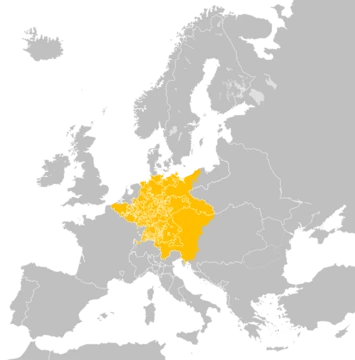
Duchy of Brittany
Not part of the Holy Roman Empire.

The duchy played a significant role in medieval European politics, with its rulers navigating complex relationships with neighboring powers such as the Duchy of Normandy and the Kingdom of France. However, it was never a part of the Holy Roman Empire, being instead a feudal state within the Kingdom of France.
Lore & Background
The duchy was politically unstable in the 10th and 11th centuries, with dukes holding limited power outside their own lands. It had mixed relationships with the Duchy of Normandy, sometimes allying and sometimes entering conflict, such as the Breton–Norman War. His son Geoffrey later became duke through marriage to Constance, the hereditary duchess.
Reader's Guide
The Duchy of Brittany's significance lies in its long-standing independence and eventual integration into France. His daughter Anne inherited the duchy, but King Charles VIII of France had her marriage annulled and married her, acquiring the title of Duke of Brittany jure uxoris. Following the French Revolution, the duchy was replaced by the French system of départements, and the modern administrative region of Brittany does not encompass the entirety of the medieval duchy. A movement for the reunification of Brittany calls for restoring the territorial integrity of the historic duchy as a region of the French Republic.
Did You Know?
- A civil war, the Breton War of Succession, broke out in the 14th century with rival claimants supported by England and France.
Political Transformation Across Eight Centuries
Austria's political identity shifted dramatically over more than a millennium, cycling through distinct titles and structures that reflected changing power dynamics. The final entry in this sequence, the Ostmark Reichsgau of Nazi Germany, represents a period of foreign occupation rather than autonomous governance. This unbroken chain of political redesignations reveals how deeply Austria's identity was tied to its relationship with broader imperial and continental power structures.
The Babenberg Succession and Its Decisive Battles
This succession war produced two notable engagements that shaped the region's military narrative. The source material categorizes outcomes across all listed conflicts using four possible results: victory, defeat, another result, or ongoing status, suggesting that the Babenberg Succession conflicts did not always resolve in clear-cut terms for the Austrian side. These two battles, separated by less than two decades, illustrate the sustained military pressure that succession disputes placed on the ducal territories. The fact that both engagements are specifically named within the broader list of Austrian wars underscores their significance in establishing the military traditions that would later define the Archduchy and, eventually, the empire. The Babenberg Succession thus serves as a foundational chapter in understanding how Austria's armed forces developed their strategic identity during the medieval period.
The Coalition Wars and Austria's Continental Front
The War of the Third Coalition, spanning from 1803 or 1805 to 1805 or 1806, is referenced through its dedicated Front: Austria listing, indicating a sustained campaign rather than a single decisive battle. The fact that three of these four coalitions are catalogued by front rather than by individual battle suggests that Austria's involvement was characterized by extended, multi-theater operations rather than isolated engagements. This pattern reveals an archducal military strategy oriented toward sustained continental defense during the Napoleonic era.
Fragmentation and Occupation in the Twentieth Century
The final decades of Austria's political history, as reflected in this military listing, reveal a troubling pattern of institutional instability and external domination. The rapid succession of political entities spanning barely two decades suggests profound difficulty in establishing a stable sovereign identity. The source's cross-references link this period to both Archduke Franz Ferdinand and Adolf Hitler, connecting the empire's end to the figure whose assassination helped trigger the First World War and to the dictator who ultimately erased Austrian sovereignty. The military history of this era is thus inseparable from questions of national survival and political continuity.
Frequently Asked Questions
What were the Duchy of Brittany's powers and political role?
Breton dukes held full feudal authority over their peninsula, managing their own laws, armies, and diplomacy while balancing pressure from the Kingdom of France and the neighboring Duchy of Normandy. The duchy's strategic position between the Bay of Biscay, the English Channel, and the Loire made it a key player in medieval Western European politics.
Why does an HRE encyclopedia even list the Duchy of Brittany?
Bre Brittany was never a duchy or electorate of the Holy Roman Empire; it was a French-adjacent feudal state that ultimately merged into the French kingdom. Its inclusion in this fan series is a comparative or thematic entry, not an assertion of imperial membership.
More in Duchies And Electorates Of The Holy Roman Empire 1-17
Spotted an error? Know more?
This is a living reference — every entry is fact-audited, and reader corrections feed straight into our audit queue. Suggest an edit · See this site's audit record