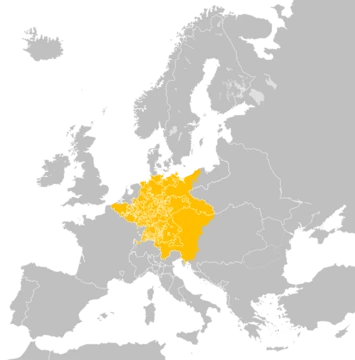
Electorate of Trier
Ecclesiastical principality and electorate of the Holy Roman Empire.

The Electorate of Trier was an ecclesiastical principality of the Holy Roman Empire, existing from the late 9th to the early 19th century. It was the temporal possession of the prince-archbishop of Trier, who served ex officio as a prince-elector of the empire, alongside the archbishops of Cologne and Mainz. The capital was Trier, though from the 16th century the main residence shifted to Koblenz. The electorate was secularized in 1803 during the German mediatisation.
- type
- Ecclesiastical principality
- existed
- Late 9th century to 1803
- capital
- Trier (later residence in Koblenz)
- ruled_by
- Prince-Archbishop of Trier (also a prince-elector)
- known_for
- One of the three ecclesiastical electors of the Holy Roman Empire
Lore & Background
The Electorate of Trier originated from the archbishopric of Trier, which had been a bishopric since Roman times and was raised to archiepiscopal status under Charlemagne.
Reader's Guide
The Electorate of Trier played a significant role in the Holy Roman Empire as one of the three ecclesiastical electors, influencing the election of German kings.
Did You Know?
- The Electorate of Trier was secularized in 1803 during the German mediatisation.
- From the 16th century onward, the main residence of the Elector was in Koblenz, not Trier.
From Roman Bishopric to Territorial Sovereign
The political identity of Trier stretches back to Roman times, when the provincial capital of Augusta Treverorum already hosted a bishop. Charlemagne elevated the see to archiepiscopal rank, naming Metz, Toul, and Verdun as subordinate dioceses. By the Merovingian period, Trier's bishops already functioned as de facto regional lords. Radbod also secured the chapter's exclusive right to elect the archbishop, free from imperial meddling. These layered grants transformed a spiritual office into a territorial lordship in its own right.
Elector, Arch-Chancellor, and Imperial Pillar
From the early thirteenth century, the Archbishop of Trier held a seat among the Imperial Electors who chose the German king, joining the archbishops of Cologne and Mainz in this exclusive ecclesiastical college. The office carried an additional, largely ceremonial title: Arch-Chancellor of Gaul. Trier's imperial significance was not merely titular. The electorate's territory stretched along the Moselle from Trier near the French border to Koblenz on the Rhine, giving the prince-archbishop a strategically vital corridor between two major rivers. From the sixteenth century onward, the Elector's principal residence shifted to Koblenz, even as Trier remained the formal capital.
Repeated French Assaults and the Unmaking of a City
Louis XIV personally ordered the demolition of nearly every castle and the burning of Trier's sole Moselle bridge. Each episode stripped the electorate of its infrastructure, population, and economic base, eroding the very foundations of the prince-archbishop's temporal authority.
The Final Elector and the End of an Era
The Electorate of Trier survived as a political entity for nearly a millennium, from the late ninth century to the early nineteenth. Its final chapter was shaped by the upheavals of the French Revolution and Napoleonic reorganization. The formal legal death came in 1803, when the German mediatisation process secularized the electorate, dissolving the prince-archbishop's temporal holdings and absorbing the territory into the restructured German states. The archdiocese, whose boundaries had never perfectly matched the electorate's borders, continued as a purely spiritual jurisdiction. The three ecclesiastical electorates—Trier, Cologne, and Mainz—disappeared as political actors, and the title of Arch-Chancellor of Gaul, attached to Trier since the thirteenth century, became a historical footnote. What had begun as a Roman provincial bishopric and grown into an independent territorial principality was, by the dawn of the nineteenth century, simply a memory.
Frequently Asked Questions
What was the Electorate of Trier?
It was an ecclesiastical principality within the Holy Roman Empire that served as the temporal domain of the prince-archbishop of Trier. It endured from the late 9th century until its dissolution in 1803.
Who ruled the Electorate of Trier and what role did they hold?
The prince-archbishop of Trier governed the territory and simultaneously sat as one of the empire's prince-electors. He shared this electoral privilege with the archbishops of Cologne and Mainz, making up the three church-held votes in imperial elections.
Where was the capital or main seat of the Electorate of Trier?
Trier itself was the formal capital, but from the 16th century the archbishops shifted their primary residence to Koblenz.
How did the Electorate of Trier come to an end?
It was secularized in 1803 during the German mediatisation, a sweeping reorganization of the empire's territorial landscape. This ended roughly nine centuries of ecclesiastical governance over the region.
Why is the Electorate of Trier significant in Holy Roman Empire history?
As one of only three ecclesiastical electorates, it granted its prince-archbishop a direct vote in selecting the Holy Roman Emperor. This made it a persistent political force alongside Mainz and Cologne throughout the empire's existence.
More in Duchies And Electorates Of The Holy Roman Empire 1-17
Spotted an error? Know more?
This is a living reference — every entry is fact-audited, and reader corrections feed straight into our audit queue. Suggest an edit · See this site's audit record