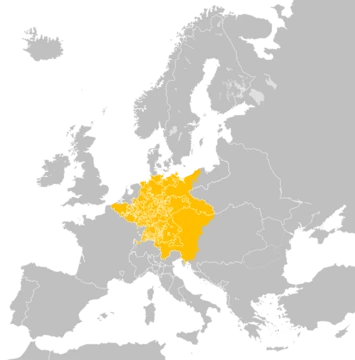
Electoral Palatinate
A key electoral state of the Holy Roman Empire.

The Electoral Palatinate was a constituent state of the Holy Roman Empire until it was annexed by the Electorate of Baden in 1803. From the end of the 13th century, its ruler was one of the Prince-electors who elected the Holy Roman Emperor, ranking them among the most significant secular Princes of the Holy Roman Empire. The Palatinate consisted of a number of widely dispersed territories, ranging from the left bank of the Upper Rhine in the modern state of Rhineland-Palatinate, adjacent parts of the French regions of Alsace and Lorraine to the opposite territory on the east bank of the Rhine in present-day Hesse and Baden-Württemberg up to the Odenwald range and the southern Kraichgau region, containing the capital cities of Heidelberg and Mannheim.
- type
- Constituent state of the Holy Roman Empire
- existed
- Until 1803 (annexed by Baden)
- capital_cities
- Heidelberg and Mannheim
- ruling_dynasty
- House of Wittelsbach (from 1214)
- known_for
- One of the Prince-electors; center of Calvinism; sparked the Thirty Years' War
Verified Timeline
Lore & Background
The Electoral Palatinate's origins trace to the Counts Palatine of Lotharingia, with Herman I mentioned in 985. The first hereditary Count Palatine of the Rhine was Conrad of the House of Hohenstaufen in 1156. The Palatinate passed to the House of Welf in 1195, then to the Wittelsbachs in 1214, who held it until 1918. In the Golden Bull of 1356, the Palatinate was recognized as one of the secular electorates, with the hereditary offices of archsteward and imperial vicar. In 1386, Rupert I helped establish the University of Heidelberg, the oldest university in Germany. In 1541, Otto Henry, Elector Palatine converted to Lutheranism. His Calvinist descendant, Frederick V, sparked the Thirty Years' War in 1618 by accepting the Crown of Bohemia. Occupied until the 1648 Peace of Westphalia, the Palatinate suffered extensive damage during the 1688 to 1697 Nine Years' War. Ruled in personal union with the Electorate of Bavaria from 1777, the Palatinate was annexed by Baden in 1803, before being absorbed by Bavaria in 1805.
Reader's Guide
The Electoral Palatinate's significance lies in its role as one of the prince-electors of the Holy Roman Empire, giving its ruler a direct voice in the election of the emperor. Its religious shifts—from Lutheranism under Otto Henry to Calvinism under Frederick III—made it a major center of Calvinist influence in Europe, supporting rebellions in the Netherlands and France. The Palatinate's acceptance of the Bohemian crown by Frederick V in 1619 triggered the Thirty Years' War, a conflict that caused over eight million fatalities. The Palatinate's territorial fragmentation across the Rhine and its eventual absorption by Bavaria in 1805 illustrate the complex political dynamics of the Holy Roman Empire's dissolution. Its legacy includes the University of Heidelberg and its role in the Protestant Union.
Did You Know?
- The first hereditary Count Palatine of the Rhine was Conrad, a younger half-brother of Emperor Frederick Barbarossa, enfeoffed in 1156.
- In 1386, Elector Rupert I helped establish the University of Heidelberg, the oldest university in Germany.
- Elector Frederick V's acceptance of the Crown of Bohemia in 1619 sparked the Thirty Years' War, which caused over eight million fatalities.
- The Palatinate was ruled in personal union with the Electorate of Bavaria from 1777.
- The Palatinate was annexed by the Electorate of Baden in 1803, then absorbed by Bavaria in 1805.
From Frankish Appointment to Hereditary Office
The title of Count Palatine traces its origins to roughly 535, when a position by that name was recorded at the Frankish court of King Childebert I. These counts originally served as the king's representatives in defined regions, a role distinct from the more autonomous dukes. Under the Merovingian dynasty the post was a purely royal appointment, yet over the centuries it gradually became a hereditary privilege. The Frankish imperial center had long been anchored at the royal palace in Aachen, within what became the Carolingian kingdom of Lotharingia, which elevated the Count Palatine of Lotharingia above all other holders of the title. By then, marital alliances had folded most palatine positions into ducal holdings, but the Lotharingian office retained its independence. In 985, Herman I of the Ezzonid line appears as count palatine of Lotharingia, though his family's feudal lands lay scattered across south-western Franconia, the Rhineland near Cologne and Bonn, and the valleys of the Moselle and Nahe. Persistent rivalry with the Archbishops of Cologne pushed the Ezzonids to shift their focus toward the southern Eifel and the Upper Rhine, where they governed counties on both banks of the river, reaching as far south as Alzey.
The Hohenstaufen Foundation and the Rise of Heidelberg
The Palatinate as a coherent hereditary entity crystallized in 1156, when the emperor enfeoffed Conrad, a Hohenstaufen prince and younger half-brother of Frederick Barbarossa, with the title of Count Palatine of the Rhine. The territories bundled into this office drew on lands the Hohenstaufens already controlled across the Donnersberg, Nahegau, Haardt, Bergstraße, and Kraichgau regions, much of it inherited from the earlier Salian emperors or acquired through Conrad's maternal connection to the Counts of Saarbrücken. Around 1182, Conrad relocated his seat from Stahleck Castle near Bacharach upstream along the Rhine to Heidelberg, a move that would anchor the region's political identity for centuries. Conrad's death in 1195 triggered a succession that passed the Palatinate to the House of Welf through the marriage of his daughter Agnes to Henry of Brunswick. After Henry's son died heirless in 1214, King Frederick II turned to the Wittelsbachs, enfeoffing Duke Louis I of Bavaria. Louis's son Otto II married Agnes of the Palatinate in 1222, and the Bavarian House of Wittelsbach would retain these territories until the fall of the monarchy in 1918.
Electoral Privilege and Imperial Office
The Golden Bull of 1356 formally enshrined the Palatinate among the secular electorates of the Holy Roman Empire, granting the Count Palatine the hereditary imperial offices of archsteward and imperial vicar for Franconia, Swabia, the Rhine, and southern Germany. From that point the ruler was commonly styled the Elector Palatine, a designation placing the house among the most consequential secular princes in the empire. The Wittelsbachs had already demonstrated their political reach: in 1294, a territorial division among the heirs of Duke Louis II of Upper Bavaria placed both the Rhenish Palatinate and the Bavarian Nordgau into the elder Wittelsbach branch, and the name Upper Palatinate became standard by the early sixteenth century to distinguish that Bavarian territory from the Rhenish Palatinate along the Rhine. In 1329, the Treaty of Pavia saw Emperor Louis IV return the Palatinate to his nephews Rudolf and Rupert I. The house's prestige reached a high point in 1386 when Rupert I helped found the University of Heidelberg, the oldest in Germany, and in 1400 when his descendant Rupert III was elected King of the Romans, though he never secured the imperial crown after being defeated in Italy en route to Rome.
Faith, War, and the End of an Era
The Palatinate's later centuries were shaped by religious upheaval and repeated military devastation. In 1541, Elector Otto Henry converted to Lutheranism, setting the region on a Protestant trajectory. That trajectory culminated in a catastrophic moment in 1618, when his Calvinist descendant Frederick V accepted the Crown of Bohemia, an act that ignited the Thirty Years' War. The Palatinate was occupied for the duration of that conflict and did not recover until the Peace of Westphalia in 1648. The region's suffering was far from over: the Nine Years' War of 1688 to 1697 inflicted extensive further damage on its already war-torn territories. By 1777, the Palatinate was ruled in personal union with the Electorate of Bavaria, a political arrangement that diminished its independent significance. The final chapter arrived swiftly: in 1803 the Palatinate was annexed by the Electorate of Baden, and just two years later, in 1805, it was absorbed into Bavaria, ending its long existence as a distinct constituent state of the Holy Roman Empire.
Frequently Asked Questions
What was the Electoral Palatinate?
It was a constituent state of the Holy Roman Empire whose ruler held one of the seven votes to choose the Emperor. Its territories were scattered across both banks of the Upper Rhine, stretching into what is now Rhineland-Palatinate, Alsace, and Lorraine.
Which dynasty ruled the Electoral Palatinate?
The House of Wittelsbach held the Palatinate from 1214 onward, making it one of the longest-continuous dynastic holdings in the Empire. Their administrative seats shifted between Heidelberg and Mannheim over the centuries.
What made the Electoral Palatinate stand out among the other electorates?
Beyond its electoral vote, the Palatinate became the spiritual heart of Calvinism in the Empire and was the state whose ruler's actions helped ignite the Thirty Years' War. That blend of religious influence and political weight made it one of the most consequential secular principalities.
How did the Electoral Palatinate come to an end?
The state was formally annexed by the Electorate of Baden in 1803, dissolving it as an independent entity. This happened in the final years before the Holy Roman Empire itself was abolished in 1806.
Why do HRE fans consider the Electoral Palatinate so important?
It sits at the intersection of virtually every major theme in Imperial history—electoral politics, the Reformation, the Thirty Years' War, and the Empire's final dissolution. Understanding the Palatinate is almost essential to grasping how the HRE's political and religious tensions played out.
More in Duchies And Electorates Of The Holy Roman Empire 1-17
Spotted an error? Know more?
This is a living reference — every entry is fact-audited, and reader corrections feed straight into our audit queue. Suggest an edit · See this site's audit record