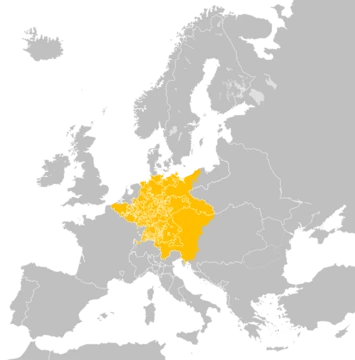
Electorate of Saxony
A key electorate of the Holy Roman Empire, centered on Saxe-Wittenberg.

The Electorate of Saxony (1356–1806) was an electorate of the Holy Roman Empire, centered on the Duchy of Saxe-Wittenberg with its capital at Dresden.
- born
- 1356 (formal establishment as electorate)
- died
- 1806 (replaced by Kingdom of Saxony)
- field
- Electorate of the Holy Roman Empire
- nationality
- German (Holy Roman Empire)
- known_for
- One of the seven prince-electors; office of Arch-Marshal of the Holy Roman Empire; strategic location along the middle Elbe
Lore & Background
Under the Wettins, Dresden became the permanent residence of the elector.
Reader's Guide
The Electorate of Saxony played a central role in the Holy Roman Empire as one of the seven prince-electors, holding the office of Arch-Marshal. Its establishment through the Golden Bull of 1356 formalized the electoral privilege for the Duchy of Saxe-Wittenberg, tying it to a specific territory. The Wettin dynasty's internal divisions and wars, such as the Saxon Fratricidal War, reflected common German dynastic conflicts, but the electorate remained a significant force until its replacement by the Kingdom of Saxony in 1806.
Did You Know?
- The Saxon electoral privilege was permanently granted to Duke Rudolf I of Saxe-Wittenberg by the Golden Bull of 1356.
The Road to the Electoral Throne
The Wittelsbach family occupied a peculiar position within the Holy Roman Empire. Their elder branch, governing the Electoral Palatinate, held one of the seven prince-electoral seats established by the Golden Bull of 1356, while the younger Bavarian line was excluded from that privilege. That imbalance was shattered in 1621, when Emperor Ferdinand II placed Frederick V, the Elector Palatine, under the imperial ban for his involvement in the Bohemian Revolt. The electoral dignity and the Upper Palatinate territory were then transferred to Frederick's loyal cousin, Duke Maximilian I of Bavaria. Although the Peace of Westphalia in 1648 created a separate new electoral title for Frederick V's son, Maximilian's descendants retained the original dignity. With the exception of a brief interlude during the War of the Spanish Succession, the Bavarian line held the vote continuously until their extinction in 1777. This single act of imperial retribution permanently reshaped the political geography of southern Germany, granting Bavaria a voice in imperial affairs that internal division had denied it for four centuries.
Maximilian I and the Forging of a State
When Maximilian I assumed the Bavarian ducal throne in 1597, he inherited a realm burdened by debt and riddled with disorder. Over the following decade, his vigorous governance produced a dramatic transformation. He reorganized the finances and the judicial system, established a professional class of civil servants, created a national militia, and absorbed several small districts under direct ducal authority. The cumulative effect was a degree of internal unity and administrative order that positioned Bavaria to act as a coherent player in the Thirty Years' War. During the conflict's earlier phase, his military success earned him the Upper Palatinate and the coveted electoral dignity. Though later reverses came, the Peace of Westphalia in 1648 confirmed his gains. The war's later years, however, brought severe suffering to Bavaria's northern regions: Swedish forces invaded in 1632, and after Maximilian violated the Treaty of Ulm in 1647, French and Swedish armies ravaged the land. He died at Ingolstadt in September 1651, leaving behind a state far stronger than the one he had found, with the Upper Palatinate making Bavaria geographically compact and the electoral vote making it politically influential.
Dynastic Complications and the Personal Union
The Wittelsbach family's dual presence in both Bavaria and the Palatinate created a complex web of succession and territorial claims that shaped the electorate's later history. After Maximilian I's line secured the original electoral dignity, the Peace of Westphalia had created a second, separate electoral title for the Palatine branch. This meant two Wittelsbach lines each claimed an imperial vote. The situation remained in tension until 1777, when the Bavarian line became extinct. At that point, the two branches were joined in personal union, effectively merging the Palatine lands—including the Electoral Palatinate, the Duchies of Jülich and Berg, Palatinate-Neuburg, Palatinate-Sulzbach, Palatinate-Veldenz, and other territories—under a single ruler. The final Palatine territory, Palatine Zweibrücken, was united with Bavaria in 1799 when its duke inherited both the Bavarian and Palatine thrones. This consolidation of the family's scattered holdings under one crown marked the culmination of a process that had begun with the 1621 transfer of the electoral dignity.
Territorial Mosaic and Administrative Evolution
The Electorate of Bavaria was far from a simple, contiguous state. Its core territory encompassed most of what are now the regions of Upper Bavaria, Lower Bavaria, and the Upper Palatinate, and before 1779 it also included the Innviertel, a region now part of Austria that was ceded to the Habsburgs by the Treaty of Teschen at the end of the War of the Bavarian Succession. Within these broad areas, however, existed a considerable number of independent enclaves and jurisdictions. These included the principalities of Palatinate-Neuburg and Palatinate-Sulzbach in the Upper Palatinate, held by cadet Wittelsbach branches; the ecclesiastical states of Freising, Regensburg, and Passau; and the imperial free city of Regensburg. For administrative purposes, Bavaria had been divided since 1507 into four stewardships: Munich, Burghausen, Landshut, and Straubing. The acquisition of the Upper Palatinate during the Thirty Years' War added the stewardship of Amberg. These stewardships were abolished in 1802 by the minister Maximilian von Montgelas, and in 1805, shortly before Bavaria's elevation to a kingdom, Tyrol and Vorarlberg were united with the electorate along with several of the enclaves.
Frequently Asked Questions
What is the Electorate of Saxony?
The Electorate of Saxony was a German state within the Holy Roman Empire, formally established in 1356 and lasting until 1806. Centered on the Duchy of Saxe-Wittenberg with its capital at Dresden, it functioned as one of the seven principal electorates that chose the Emperor.
What special imperial office did the Prince-Elector of Saxony carry?
In addition to casting a vote for the Emperor, the Saxon elector served as the Arch-Marshal of the Holy Roman Empire, a prestigious ceremonial and administrative role that set the electorate apart in the imperial hierarchy.
How did the Electorate of Saxony come to an end?
In 1806 the electorate was formally replaced by the Kingdom of Saxony, stripping it of its electoral seat and ending its role as one of the seven imperial electors. This transformation coincided with the broader restructuring of the Holy Roman Empire itself.
Why was the Electorate of Saxony strategically significant within the Empire?
Its position along the middle Elbe made it a vital geographic crossroads in central Europe, controlling key trade and military routes. This location gave the Saxon rulers outsized influence over the movement of goods and armies across the imperial heartland.
More in Duchies And Electorates Of The Holy Roman Empire 1-17
Spotted an error? Know more?
This is a living reference — every entry is fact-audited, and reader corrections feed straight into our audit queue. Suggest an edit · See this site's audit record