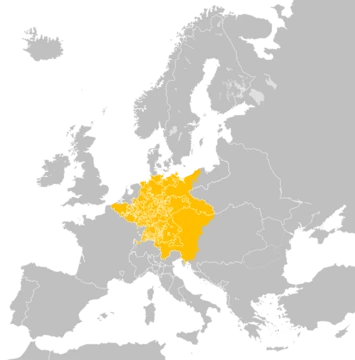
Electorate of Mainz
One of the most prestigious states of the Holy Roman Empire.

The Electorate of Mainz (German: Kurfürstentum Mainz or Kurmainz; Latin: Electoratus Moguntinus), previously known in English as Mentz and by its French name Mayence, was one of the most prestigious and influential states of the Holy Roman Empire. The Archbishop-Elector of Mainz was also the Primate of Germany (primas Germaniae), a purely honorary dignity, and served as archchancellor of Germany, ranking first among all ecclesiastical and secular princes of the Empire, second only to the Emperor.
- type
- Ecclesiastical principality of the Holy Roman Empire
- capital
- Mainz
- dissolved
- 1803 (secularization); 1802 lost archiepiscopal character
- known_for
- One of three ecclesiastical Prince-electors; archchancellor of Germany; largest ecclesiastical province in Germany
- language
- German, Latin
Lore & Background
The episcopal see was established in ancient Roman times in the city of Mainz, which had been a Roman provincial capital, Moguntiacum. The first bishops before the 4th century have legendary names, beginning with Crescens. Another early bishop of Mainz was Aureus of Mainz. The territory of the Electorate included several non-contiguous blocks of territory: lands near Mainz on both the left and right banks of the Rhine; territory along the Main River above Frankfurt (including the district of Aschaffenburg); the Eichsfeld region in Lower Saxony and Thuringia; and the territory around Erfurt in Thuringia. During the early modern period, the cathedral chapter of Mainz controlled the election of the archbishop and used its power to ensure only its members were elevated. By this time membership in the chapter had been monopolized by a few families of Imperial Knights, securing their power within the Electorate.
Reader's Guide
The Electorate of Mainz held a unique position in the Holy Roman Empire as the foremost ecclesiastical electorate, with its archbishop serving as archchancellor of Germany and ranking first among all princes after the Emperor. This political role, particularly as an intermediary between the Estates of the Empire and the Emperor, was considerable. The archdiocese of Mainz was the largest ecclesiastical province of Germany, covering Mainz and 10 suffragan dioceses. The Electorate's influence was rooted in its ancient see, established in Roman Moguntiacum, and its elevation under St. Boniface and Lullus. However, its power was curtailed by the secularizations of 1803, when the Reichsdeputationshauptschluss dissolved the electorate, transferring its left bank territories to France, right bank areas to Hesse-Darmstadt and Nassau, and Eichsfeld and Erfurt to Prussia. The modern Roman Catholic Diocese of Mainz was founded in 1802, losing its archiepiscopal status, and later extended over Hesse-Darmstadt, retaining the medieval tradition of cathedral chapter election.
Did You Know?
- The Archbishop-Elector of Mainz was also the Primate of Germany, a purely honorary dignity.
- There were only two other ecclesiastical Prince-electors in the Empire: the Electorate of Cologne and the Electorate of Trier.
- In 1802, Mainz lost its archiepiscopal character and became a mere diocese within the territory of France.
Ecclesiastical and Political Prestige
The Electorate of Mainz occupied a singular position at the intersection of sacred authority and imperial governance. Its holder, the Archbishop-Elector, carried the title of Primate of Germany—a purely honorary distinction that other archbishops occasionally contested but never successfully claimed. Beyond this spiritual rank, the Mainz prince held the office of archchancellor of Germany, one of three titular kingdoms within the Holy Roman Empire alongside Italy and Burgundy. This chancellery gave him a seat at the very top of the imperial hierarchy: he ranked above every other ecclesiastical and secular prince in the Empire and stood second only to the Emperor himself. His practical political function was equally significant, as he served as a key intermediary between the Estates of the Empire and the imperial throne. Among the three ecclesiastical prince-electors—Mainz, Cologne, and Trier—Mainz's combination of primacy, chancellery, and electoral vote made it arguably the most prestigious of the three.
Roman Roots and the Bonifacian Transformation
The episcopal see of Mainz traces its origins to the Roman provincial capital of Moguntiacum, where the city had already held administrative importance before Christianity took root. For centuries the see remained modest in stature. Although Boniface had previously held the title of archbishop, that elevated status did not automatically transfer to the see itself. Another notable early figure was Aureus of Mainz. The leap from a provincial Roman capital's modest bishopric to an archdiocese of the first rank marked the beginning of Mainz's long association with ecclesiastical supremacy in the German lands.
Fragmented Territory and Chapter Governance
Unlike many contiguous states, the Electorate of Mainz was a patchwork of non-contiguous territories scattered across the Empire. Its holdings included lands on both banks of the Rhine near Mainz, stretches along the Main River above Frankfurt encompassing the Aschaffenburg district, the Eichsfeld region spanning Lower Saxony and Thuringia, and the area surrounding Erfurt. Importantly, this political territory was distinct from the purely spiritual jurisdiction of the archdiocese. By the early modern era, the archdiocese of Mainz had grown into the largest ecclesiastical province in Germany, encompassing the metropolitan see plus ten suffragant dioceses. Governance of the see was tightly controlled: the cathedral chapter managed the election of each new archbishop and, over time, restricted membership to a small circle of Imperial Knight families. This oligarchic arrangement allowed those families to entrench their influence within the Electorate, ensuring that the selection of the archbishop remained an internal family matter rather than an open contest.
Secularization, Dalberg, and the Modern Diocese
The Electorate's existence as a sovereign entity ended in the early nineteenth century. In 1802, Mainz shed its archiepiscopal character, and the following year the Reichsdeputationshauptschluss triggered sweeping secularizations. The incumbent elector, Karl Theodor von Dalberg, saw his seat transferred to Regensburg. His left-bank Rhine territories were ceded to France, the right-bank Main areas below Frankfurt went to Hesse-Darmstadt and the Nassau princes, while Eichsfeld and Erfurt passed to Prussia.
Frequently Asked Questions
What was the Electorate of Mainz?
It was an ecclesiastical principality of the Holy Roman Empire centered on the city of Mainz, governed by an Archbishop-Elector who held one of the three church-based votes for choosing the Emperor. It is also referred to by its Latin name Moguntinus or its older English rendering Mentz.
What titles and duties did the Elector of Mainz hold within the Empire?
The Archbishop-Elector served as archchancellor of Germany, a role that placed him first in rank among all ecclesiastical and secular princes, second only to the Emperor. He additionally bore the honorary title of Primate of Germany (primas Germaniae), though this carried no real administrative power.
Why is the Electorate of Mainz regarded as one of the most prestigious states of the Holy Roman Empire?
As one of only three ecclesiastical Prince-electors, it played a decisive role in imperial elections, while its archchancellor position gave it a leading seat in imperial governance. It also administered the largest ecclesiastical province in Germany, granting it sweeping spiritual jurisdiction.
How did the Electorate of Mainz come to an end?
The secularization of 1803 dissolved the territory as a sovereign state within the Empire, ending its political existence. Just a year earlier, in 1802, it had already been stripped of its archiepiscopal status, marking the final unraveling of an institution that had endured for over a millennium.
More in Duchies And Electorates Of The Holy Roman Empire 1-17
Spotted an error? Know more?
This is a living reference — every entry is fact-audited, and reader corrections feed straight into our audit queue. Suggest an edit · See this site's audit record