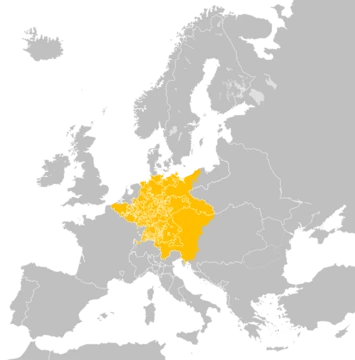
Duchy of Burgundy
Medieval duchy that grew into a major Burgundian State.

The Duchy of Burgundy was a medieval and early modern feudal polity in the north-western regions of historical Burgundy. It was a duchy, ruled by dukes of Burgundy, and belonged to the Kingdom of France. The duchy was distinct from the neighboring Free County of Burgundy (modern Franche-Comté).
- Capital
- Dijon (implied by region)
- Dynasties
- House of Burgundy (Capetian cadet), House of Valois-Burgundy
- Notable Rulers
- Richard the Justiciar, Philip the Bold, Charles the Bold
- Region
- North-western historical Burgundy, later expanded to Low Countries
Lore & Background
The Duchy of Burgundy emerged from the earlier Kingdom of the Burgundians, an East Germanic tribe that settled in Gaul in the 5th century. Under the Carolingians, Burgundy became a mainly geographical term, and the duchy arose from counties in the northwestern part of historical Burgundy after the collapse of Carolingian centralism.
Reader's Guide
The Duchy of Burgundy was significant as one of the largest ducal territories in early modern Europe. The Valois-Burgundy dukes acquired the County of Burgundy, Holland, and Luxemburg, creating a realm stretching from the Alps to the North Sea, reminiscent of Lotharingia. His death led to the duchy being absorbed into French crown lands by Louis XI, while the Burgundian possessions in the Low Countries passed to his daughter Mary and her Habsburg descendants.
Did You Know?
- The Burgundian State under Valois-Burgundy stretched from eastern France and Franche-Comté to the Low Countries, but did not include the western Alps.
From Carolingian Roots to a Divided Duchy
The Duchy of Lorraine traces its origins through a layered sequence of Carolingian and post-Carolingian political entities. Before its formal creation, the region passed through the Mosellan duchy of the early ninth century, the distinctive realm of Lotharingia under kings Lothair II and Zwentibold, and the Stem Duchy of Lotharingia in the early tenth century. Because the southern portion lay further upstream along the river system, it earned the 'upper' designation. Situated along the Moselle, it was initially styled the Duchy of Mosellans, and its ruler carried the title Duke of Mosellans through the eleventh and twelfth centuries, a nomenclature preserved in both charters and narrative sources of the period.
A Borderland Torn Between Empires
Lorraine's position astride the border between the Holy Roman Empire and the Kingdom of France made it a perpetual prize for neighboring powers. Both the dukes of Burgundy and the French monarchs coveted the territory, and it was briefly occupied by each at different points in its history.
The Stanisław Arrangement and Final Annexation
The last chapter of Lorraine's ducal independence was written through a striking diplomatic compromise following the War of the Polish Succession. Stanisław was also the father-in-law of King Louis XV of France. The arrangement carried a clear condition: upon his death, the duchy would revert to the French crown.
Names, Languages, and Dynastic Echoes
The duchy's name carries etymological weight stretching back to its Carolingian founders. In Latin, the standard designation was Ducatus Lotharingiae, which produced the German Herzogtum Lothringen and the French Duché de Lorraine. In the Alemannic German once spoken across the region, the suffix -ingen signified a property, so the German form Lotharingen figuratively translates as 'Land belonging to Lothair' or, more simply, Lothair's realm. The duchy lent its name to the present-day region of Lorraine in northeastern France, with Nancy serving as its capital throughout its existence. Its most far-reaching legacy is dynastic: the title Duke of Lorraine was retained by Francis Stephen and appears prominently in the family name of his successors, the House of Habsburg-Lorraine. Two regional languages also persist in the area, including Lorraine Franconian, known locally as francique or platt lorrain, preserving a linguistic thread to the duchy's medieval past.
Frequently Asked Questions
What distinguished the Duchy of Burgundy from the Free County of Burgundy?
The Duchy was a hereditary fief held directly from the French king, centered on the area around Dijon. The Free County (later Franche-Comté) was a separate feudal entity with its own obligations and was never part of the ducal territory, despite the shared name.
More in Duchies And Electorates Of The Holy Roman Empire 1-17
Spotted an error? Know more?
This is a living reference — every entry is fact-audited, and reader corrections feed straight into our audit queue. Suggest an edit · See this site's audit record