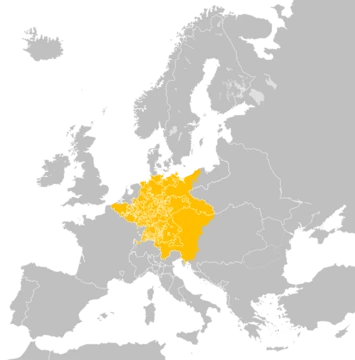
Electorate of Cologne
Ecclesiastical principality of the Holy Roman Empire.

The Electorate of Cologne (German: Kurfürstentum Köln), also known as Electoral Cologne, was an ecclesiastical principality of the Holy Roman Empire from the 10th to the early 19th century. It consisted of the temporal possessions of the archbishop of Cologne, who ruled as prince-elector. As one of only three ecclesiastical prince-electors, alongside Mainz and Trier, the archbishop-elector of Cologne also served as arch-chancellor of Italy and ranked second among all imperial princes, after Mainz and before Trier.
- type
- Ecclesiastical principality
- existed
- 10th century to early 19th century
- capital
- Cologne (later Bonn)
- ruled_by
- Archbishop-elector of Cologne
- rank_in_empire
- Second among ecclesiastical and secular princes
- arch-chancellor_of
- Italy
Lore & Background
By the late 12th century, the Archbishop of Cologne was one of the seven electors of the Holy Roman Emperor. The electorate's territory included a strip along the left bank of the Rhine east of Jülich and the Duchy of Westphalia beyond the Rhine.
Reader's Guide
The Electorate of Cologne played a significant role in the political and religious history of the Holy Roman Empire. As an ecclesiastical principality, it exemplified the fusion of spiritual and temporal authority. The archbishop-elector's rank as second only to Mainz underscored its importance.
Did You Know?
- The archbishop-elector of Cologne was also arch-chancellor of Italy, one of the three titular kingdoms of the Holy Roman Empire.
Origins and Electoral Rank
This move was deliberately designed to counterbalance the power of the secular nobility that threatened imperial authority. Over time, the territory coalesced from the archbishop's temporal holdings into a strip of land along the left bank of the Rhine east of Jülich, plus the Duchy of Westphalia on the opposite side, beyond Berg and Mark. By the close of the 12th century, the archbishop had secured a seat among the seven electors of the Holy Roman Emperor. Only two other ecclesiastical prince-electors existed in the Empire, making Cologne a uniquely powerful spiritual-political entity for nearly nine centuries.
The Struggle for Urban Autonomy
The relationship between the archbishop-elector and the citizens of Cologne was defined by persistent friction. This defeat effectively ended the archbishop's direct rule over the city. Political tensions continued over taxation, public spending, business regulation, and market supervision, as well as the boundaries of corporate autonomy. The archbishop ultimately relocated his seat to Bonn to escape ongoing jurisdictional disputes with the city government.
The Cologne War and the Wittelsbach Era
His actions triggered the election of a rival archbishop, Ernst of Bavaria, brother of the Wittelsbach duke. The resulting Cologne War pitted papal-funded Italian and Spanish mercenaries alongside Catholic Bavarian forces against von Waldburg, who received support from the Protestant Netherlands. The conflict devastated the electoral economy, with numerous villages and towns besieged and destroyed. Von Waldburg eventually abandoned his claim and retired to Strasbourg with his wife. Ernst's victory marked the first major Counter-Reformation success in Germany, and under his direction Jesuits oversaw the restoration of Catholicism.
Trade, the Hanseatic League, and Economic Identity
Cologne's economic life was anchored in its position as a major Rhine harbor and transport hub, connecting the city to a vast network of Northern European commerce. As one of the chief cities of the Hanseatic League—alongside Hamburg, Bremen, and Lübeck—Cologne participated in a business alliance of trading towns and their guilds that dominated coastal trade from roughly the 1200s through the 1500s. The city's medieval and early modern economic structures depended on its entrepreneurial merchants, who cultivated commercial ties with counterparts in other Hanseatic cities. This trade infrastructure gave Cologne a distinct economic identity separate from the archbishop's political authority, and it helped explain why the city's merchants and guilds resisted the elector's attempts at fiscal and regulatory control. The long-distance Baltic trade that the league facilitated provided a commercial backbone that sustained the city's prosperity across centuries of political upheaval.
Frequently Asked Questions
What was the Electorate of Cologne?
It was a church-governed territory within the Holy Roman Empire, where the archbishop of Cologne held both spiritual authority and secular rule as a prince-elector. The entity spanned from the 10th century through the early 1800s.
What made Cologne one of the 'special' electorates?
Cologne was one of only three ecclesiastical (bishop-led) electorates in the empire, the others being Mainz and Trier. Its ruler additionally carried the imperial title of arch-chancellor of Italy, a distinction no secular prince-electors held.
Who actually governed the Electorate of Cologne?
The archbishop of Cologne served as both head of the diocese and sovereign of the territory, ruling as a prince-elector. The capital was originally the city of Cologne itself, later shifting to Bonn.
Where did Cologne rank among all the imperial princes?
The archbishop-elector of Cologne held the second-highest position in the imperial hierarchy, slotting in directly behind Mainz and ahead of Trier. This ranking applied across both ecclesiastical and secular princes alike.
How did the Electorate of Cologne's story end?
It persisted as a functioning political unit from the 10th century until the early 19th century, when the Napoleonic reorganization of German lands dissolved the old Holy Roman Empire structure. Its temporal possessions were absorbed into the new territorial order, ending centuries of archiepiscopal rule.
More in Duchies And Electorates Of The Holy Roman Empire 1-17
Spotted an error? Know more?
This is a living reference — every entry is fact-audited, and reader corrections feed straight into our audit queue. Suggest an edit · See this site's audit record